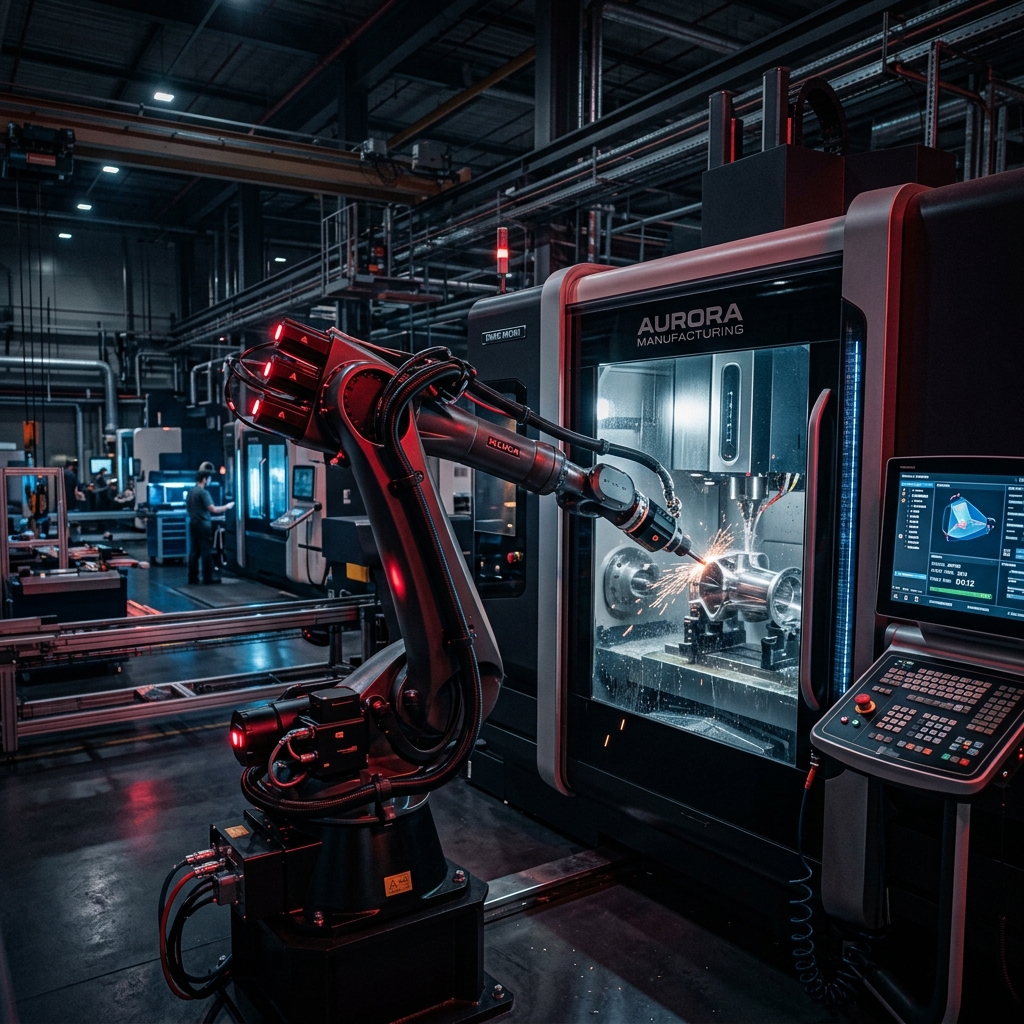
Global manufacturing is undergoing a structural shift. Labor shortages, fluctuating supply chains, and demanding tolerances have pushed automation from a luxury to an existential necessity. Within this modernization landscape, industrial robotics integration stands as the single most effective method for establishing continuous, predictable production throughput.
Integrating a robot arm into a factory floor is far more than purchasing an arm off the shelf. True automation requires the design of a complete **robotic cell**—which includes safety fencing, specialized end-of-arm tooling (grippers), advanced 2D/3D vision tracking, and seamless communications with machine tools. Here, we analyze the critical trends shaping the industry in 2026 and outline the engineering best practices for deploying autonomous cells.
Key Robotics Trends Driving Manufacturing in 2026
As technology matures, three primary pillars are redefining how robots interact with human workers and factory ecosystems:
1. High-Payload Collaborative Robots (Cobots)
Historically, collaborative robots were limited to light payloads (under 10kg) and slow speeds. In 2026, new heavy-duty cobots (such as Fanuc’s CRX series) handle payloads up to 30kg. These systems use highly responsive force-torque sensors to halt instantly upon touching a human, eliminating the need for bulky physical enclosures and saving vital floor space.
2. AI-Driven 3D Bin Picking
Traditional robots required parts to be perfectly oriented in customized trays. Today, integrating structured-light 3D cameras and machine learning allows robots to pick randomized parts directly from a bulk bin. The system calculates optimal approach angles and collision avoidance paths on the fly, eliminating sorting labor entirely.
3. Unified PLC and Robot Programming
System architectures have shifted away from maintaining separate control systems for the factory line and the robot arm. Modern industrial networks (such as EtherNet/IP and PROFINET) allow engineers to control and monitor the robot directly from the main factory PLC, streamlining debug times and easing operator management.
"Successful robotics integration is not about replaced human labor; it is about creating a harmonious, safety-certified industrial cell where human cognitive skill and machine repetition amplify output."
Step-by-Step Robotics Integration Guidelines
A failed robotics project is almost always the result of poor planning or lack of communication protocols. To ensure a successful installation, CncSonic utilizes a strict integration blueprint:
Phase 1: Defining the Scope & Cycle-Time Studies
We analyze the component weight, shape, surface finish, and target output. Through virtual simulation, we model the robot's physical reach, joint speeds, and payload inertia to guarantee that the cell meets the target cycle time before manufacturing any hardware.
Phase 2: End-of-Arm Tooling (EOAT) Design
The gripper is the robot’s point of contact with the product. Depending on the task, we engineer custom pneumatic, hydraulic, magnetic, or vacuum grippers—often incorporating dual-grip designs so the robot can unload a finished part and load a raw blank in a single sequence, saving crucial cycle seconds.
Phase 3: Machine Tool Interfacing (Handshake Protocols)
For machine tending (loading/unloading CNC lathes or mills), the robot and the CNC controller must share a robust communications protocol. We establish clear I/O signal handshakes:
CNC Door Opened -> Robot Enters -> Part Gripped -> Chuck Unclamped -> Part Removed -> New Part Loaded -> Chuck Clamped -> Robot Exits -> CNC Door Closed -> Cycle Start.
Phase 4: Safety Certification (ISO 10218-2)
No cell is complete without safety validation. We design safety interlocks, light curtains, area scanners, and safety-rated monitoring (DCS - Dual Check Safety) to ensure that if a human enters the cell boundary, the robot instantly slows down or stops.
Maximizing ROI with Autonomous Cells
An integrated robotic cell consistently runs during breaks, shift changes, and overnight ("lights-out" manufacturing). This consistency results in a highly predictable parts-per-hour output. Scrap rates drop significantly because parts are loaded with sub-millimeter precision every single time, protecting both spindle tooling and raw material. Typically, manufacturers see full ROI on their integration projects within 18 to 24 months, with cells remaining operational for well over a decade.