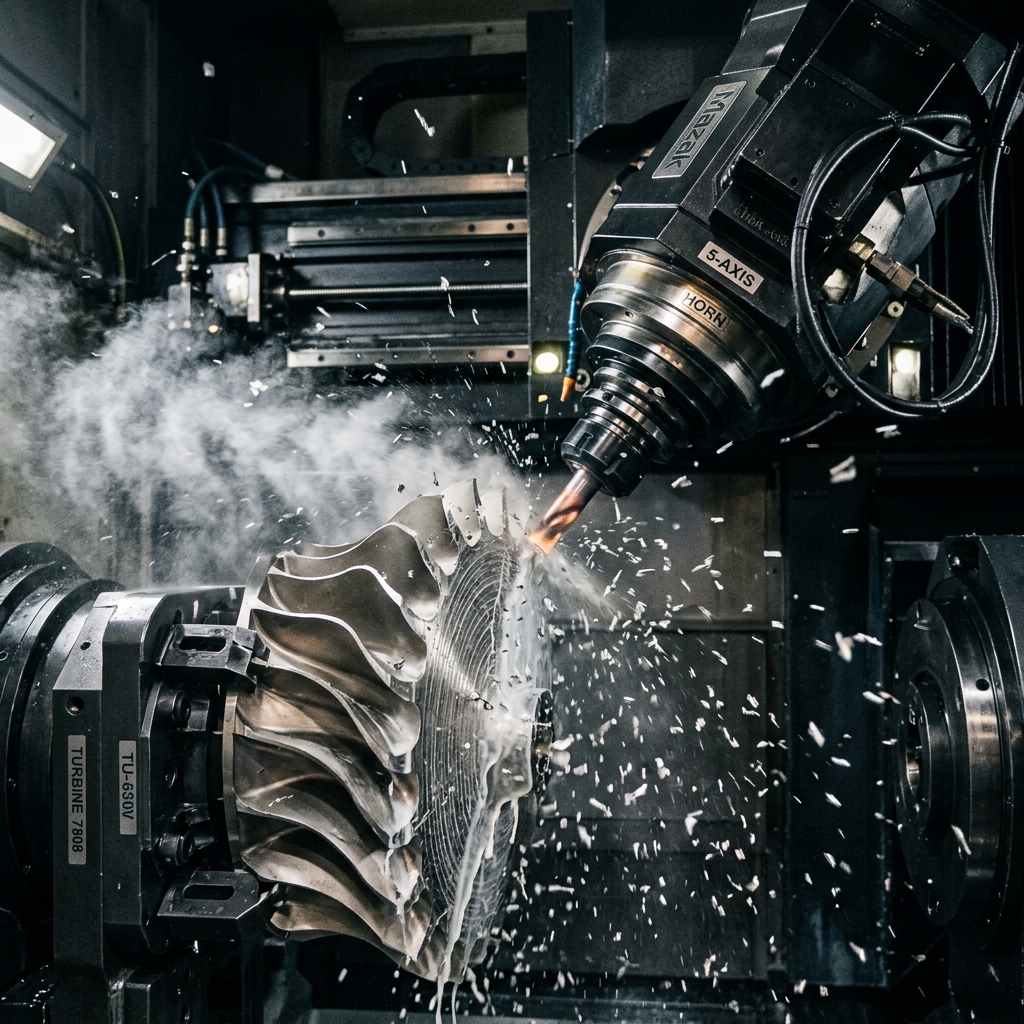
In aerospace manufacturing and precision mold making, 5-axis simultaneous CNC milling represents the pinnacle of machining technology. These systems allow complex titanium or nickel-alloy geometries to be cut within sub-micron tolerances.
However, 5-axis kinematic control is mathematically complex. Any micro-alignment error on the rotary axes (A, B, or C) or slow block processing speeds from an older controller causes surface waviness, scrapping parts. This guide details the critical engineering steps for 5-axis modernizations using Fanuc solutions.
Key Milestones in 5-Axis Revision
Upgrading a 5-axis machine tool goes far beyond replacing cabinet boards; kinematic safety and axis synchronization are paramount:
- Kinematic Calibration: Automatically detecting rotational axis centers using Fanuc's built-in 3D coordinate packages (G68.2 Tilted Working Plane & G43.4 Tool Center Point Control - TCP).
- High-Speed Processing: Complex aerospace geometries generate millions of blocks of G-code. A modern Fanuc 31i-B5 controller handles 1000+ blocks per second with AICC II contour control.
- Direct Feedback Integration: Installing rotary encoders or optical scales directly on tables or heads. This sets up a closed-loop system, correcting thermal expansion drift.
"In an aerospace supplier project in Ankara, we modernized a 5-axis gantry mill using a Fanuc 31i-B5. Kinematic tuning corrected part tolerances down to 3 microns."
ROI of 5-Axis Modernization
Due to the high acquisition cost of new 5-axis machinery, retrofitting represents a major cost saver, requiring **only 30%** of the budget of a new asset. Modernizing the system guarantees aerospace contract compliance and returns obsolete hardware to a highly productive state.